Product News
A Lifesaving Collaboration Built on Swiss Watch Precision
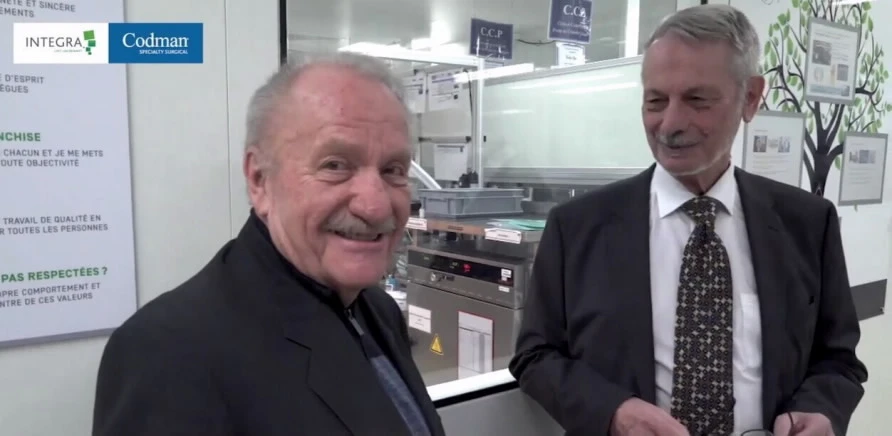
Luc Tissot, a visionary keenly attuned to the latest technological advances, created the Tissot Foundation in 1980 with the idea of applying the precision of Swiss watchmaking to other industries such as medical technologies. Coincidentally, in another part of the world, Professor Salomón Hakim, a leading neurosurgeon from Bogotá, Colombia, was looking for a way to perfect a programming system – inspired by watchmaking technologies – to regulate pressure in the brain and better treat hydrocephalus. That’s when he turned to Luc Tissot.
From this incredible collaboration between Luc Tissot, Professor Hakim, and Tissot engineer Jean-Jacques Dessaules, emerged the world’s first programmable valve to treat hydrocephalus, known as the Codman® Hakim® Programmable Valve.
When Luc Tissot financed and contributed to development of the Hakim valve, he had no idea that 30 years later he would suffer from hydrocephalus and personally benefit from this technology.
“Four years ago, I started to experience balance problems while walking,” said Tissot. “I went through a series of tests and results revealed my intracranial pressure was way above normal. After the diagnosis, I was implanted with the Hakim valve and all my balance problems disappeared. It was an extraordinary feeling being able to walk normally again!”
“I never thought that one day, I would benefit from this product I helped develop. It is truly remarkable.
Codman® Hakim® Programmable Valves
Indications
The Codman® Hakim® Programmable Valves are implantable devices that provide constant intraventricular pressure and drainage of CSF for the management of hydrocephalus.
Contraindications
The Codman® Hakim® Programmable Unitized Valve Systems are not recommended for atrial placement. Use the non-unitized versions for this procedure. These devices are contraindicated in patients receiving anticoagulants or known to have a bleeding diathesis. Avoid shunt implantation if infection is present within the body. Delay the shunt procedure when infections such as meningitis, ventriculitis, peritonitis, bacteremia, and septicemia are present.
Warnings
Subjecting the valve to strong magnetic fields may change the setting of the valve.
- The use of Magnetic Resonance (MR) systems up to 3 T will not damage the valve mechanism but may change the setting of the valve. Confirm the valve setting after an MRI procedure. See Programming the Programmable Valve.
- Common magnets greater than 80 gauss, such as household magnets, loudspeaker magnets, and language lab headphone magnets, may affect the valve setting when placed close to the valve.
- Magnetic fields generated from microwaves, high-tension wires, electric motors, transformers, etc., do not affect the valve setting. Read MRI Information before performing an MRI procedure on a patient implanted with the programmable valve. Any magnet may experience a degradation of magnetic field strength as a consequence of exposure to the significantly stronger magnet field induced in an MRI procedure.
- Based on the coercivity of the CHPV magnet material, the valve is resistant to magnetic degradation in a 1.5T MRI.
- Testing of the CHPV valve following exposure to 10 simulated MRI procedures at 3T indicates there may be demagnetization that, subsequently, could lead to a reduction in the ability to program the valve. Please refer to Troubleshooting section should any difficulty in programming occur. The SIPHONGUARD® device is intended to reduce the rapid flow of CSF. It also reduces the ability to prime the shunt system during implantation to a rate of approximately 0.5 mL/minute.
Precautions
The programmable valves are supplied without a specific programmed pressure and must be programmed prior to use.
Inspect the sterile package carefully. Do not use if:
- the package or seal appears damaged,
- contents appear damaged, or
- the expiry date has passed.
This is an adjustable valve and the surgeon must take that into account when evaluating patients. It is important to verify the current pressure setting as part of any treatment plan.
Do not allow the programming unit or transmitter unit to remain in environmental extremes.
After exposure of the programming unit or the transmitter unit to environmental extremes, such as those found in transport or storage, allow the unit to come within operating range before operating.
Do not program the valve on a metal surface, such as a Mayo stand.
While becoming familiar with valve programming, it is recommended that the pressure setting of the implanted valve be changed in increments of no more than ±40 mm H2O (392 Pa) in a 24-hour period. Patients whose pressure setting has been changed should be carefully monitored during the first 24 hours post programming. It is recommended that x-rays be taken to confirm the changes made to valve pressure setting.
Before use, check the programming unit and transmitter unit connections, settings, and function (see Preimplantation Programming Familiarization Procedure in IFU).
Use only Integra branded programmers to program the pressure of the CODMAN® HAKIM® Programmable Valve.
Unauthorized modifications to the programming unit or transmitter unit may cause a malfunction that could result in serious patient injury or death.
Electrical shock hazard: Do not open the programming unit or transmitter unit. Refer servicing to qualified service personnel.
Explosion hazard: Do not use the programming unit in the presence of flammable materials; i.e., anesthetics, solvents, cleaning agents, and endogenous gases.
Before turning on the 100/120, 220/240 VAC programming unit (catalog no. 82-3121 or 82-3190), verify that the supply voltage selector on the rear of the unit is set to the correct voltage for the electrical outlet.
Do not move the transmitter unit during programming.
Never immerse the programming unit or the transmitter unit in any liquid.
Do not sterilize the programming unit or the transmitter.
Use only with components compatible with the dimensions shown in the Device Description section of the IFU.
Aseptic technique is necessary in all phases of the use of this product.
Silicone has a low cut and tear resistance; therefore, exercise care when placing ligatures so as not to tie them too tightly. The use of stainless steel ligatures on silicone rubber is not recommended.
Do not use sharp instruments when handling the silicone valve or catheter; use shod forceps. Cuts or abrasions from sharp instruments may rupture or tear the silicone components.
Do not fold or bend the valve during insertion. Incorrect insertion may cause rupture of the silicone housing.
To better stabilize the position of the valve underneath the scalp, proper valve placement is required. Place the flat underside of the valve against the bone, with the round top surface facing upward.
Verify proper placement and integrity of ligatures at all tubing junctions to prevent obstruction of the catheter lumen and tears or abrasions of the silicone tubing.
Do not fill, flush, or pump the valve with fluid in which cotton, gauze, or other lint-releasing material has been soaked.
Exercise extreme care to prevent the silicone components of the system from coming in contact with bare fingers, towels, drapes, talc, or any linty or granular surfaces. Silicone rubber is highly electrostatic and, as a result, attracts airborne particles and surface contaminants that could produce tissue reaction.
After implantation, avoid unnecessary pumping of the prechamber and pumping chamber to prevent rapid alteration of the intraventricular pressure.
Cylindrical Valves only: Before closing the scalp incision (or mastoidal incision, if a two-step passage technique is employed), confirm that the direction-of-flow arrow on the valve faces up.
Codman® Hakim® Programmer
Indications and Usage
The HAKIM® Programmer and Transmitter are designed for use only with CODMAN® HAKIM Programmable Valves in the treatment of hydrocephalus when shunting cerebrospinal fluid (CSF) from the ventricles of the brain.
Codman® VPV Programmer
Indications
The System is designed for use only with CODMAN® HAKIM® Programmable Valves in the treatment of hydrocephalus when shunting cerebrospinal fluid (CSF) from the ventricles of the brain. It is used to noninvasively adjust the CODMAN® HAKIM® Programmable Valve to the selected setting and provides confirmation of the valve adjustment, without the need for radiographic imaging when an “Adjustment Complete” message is displayed.
Contraindications
There are no known contraindications for the use of the CODMAN® VPV System.
MANUFACTURER
Integra LifeSciences Switzerland Sarl
Rue Girardet 29 (2nd Floor)
Le Locle Neuchatel CH-2400 ■ Switzerland