
Nasal Airway Obstruction (NAO)
About the Condition
Nasal Airway Obstruction (NAO) Symptoms
If you’re having trouble breathing through your nose, you may be suffering from nasal airway obstruction. Common symptoms of NAO include:1,2,3
- Stuffy nose or nasal congestion
- Restricted nasal airflow
- Snoring or difficulty sleeping
- Fatigue
- Headache
- Difficulty breathing through the nose during physical activity

Please Note: The Find your Doctor locator ("Locator") provided here is intended for use by the general public as a quick reference for patients wanting to locate physicians who perform procedures with the Acclarent portfolio. Integra LifeSciences and its parents, subsidiaries, affiliates, directors, officers, employees, agents, and representatives (collectively "Integra") does not, in anyway, endorse the individuals, institutions or group practices included in the Locator. Similarly, any omission from the Locator does not suggest disapproval or any other position or assessment by Integra.
NAO Causes
In terms of what causes NAO, blockage in the nose can restrict normal airflow and make it difficult for you to breathe through one or both sides of your nose.4 Structural blockages may occur naturally or can be caused by injury to the nose. Obstructions are typically found in three sections of the nose:
- The septum is the thin wall of cartilage that divides your left and right nostrils—an off-center or bent septum (also known as a deviated septum) can obstruct airflow.
- The nasal turbinates are narrow passages that moisten and warm the air you breathe into your nose—if they become inflamed and enlarged, airflow through your nose can be blocked.
- The lateral wall is formed by several bones in your nasal cavity—if this structure is unstable, collapses or swells, airflow can be restricted and cause difficulty breathing.

Nasal Airway Obstruction and Quality of Life
Normal breathing through the nose is something most people take for granted. Nasal Obstruction is an annoying symptom that greatly affects quality of life (QOL).5

The Nasal Obstruction Symptom Evaluation (NOSE) Survey
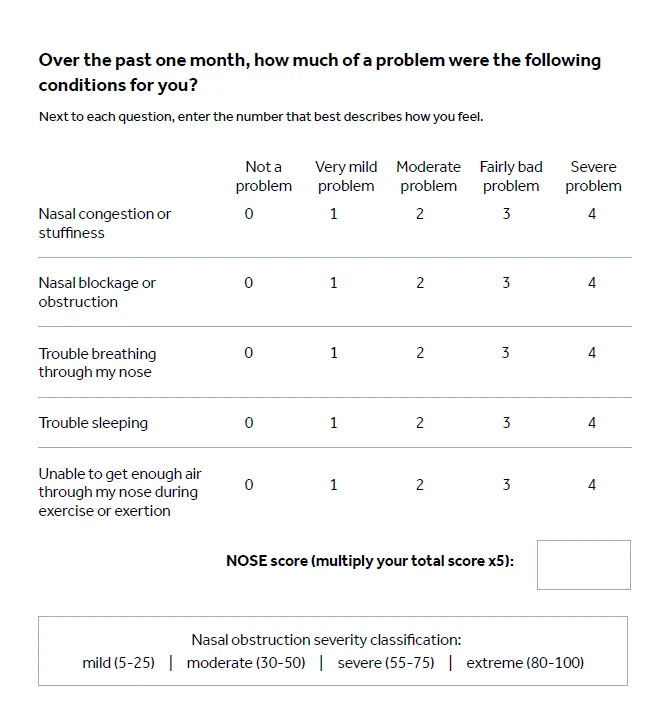
Is Nasal Airway Obstruction Adversely Affecting Your Daily Life?
The Nasal Obstruction Symptom Evaluation (NOSE) Survey3 is a tool for assessing the disease-specific quality of life related to nasal obstruction. This five-question, validated survey uses a 20-point scale capturing your different breathing symptoms. Higher scores indicate more severe symptoms than lower scores.
Nasal Airway Obstruction: Helpful Information
Nasal congestion is a common condition that affects tens of millions of people in the U.S. each year.6 By restricting airflow through the nose, NAO can contribute to other health-related conditions as well as negatively affecting daily life, from performance at work to enjoyment of activities with friends and family.7
Why is nasal breathing so important? Most air inhaled into the lungs passes through the nose. And, nasal breathing has significant health benefits compared to mouth breathing.

Disclaimer: The information featured here is not intended as medical advice, or to be used for medical diagnosis or treatment. Please talk to your doctor if you have questions. This content is intended for audience within the US only.
References
- Radenne F, Lamblin C, Vandezande LM, et al. Quality of life in nasal polyposis. J Allergy Clin Immunol 1999;104:79–84.
- Rhee JS, Book DT, Burzynski M, Smith TL. Quality of life assessment in nasal airway obstruction. Laryngoscope 2003;113:1118 –1122.
- Lipan MJ1, Most SP. Development of a severity classification system for subjective nasal obstruction. JAMA Facial Plast Surg. 2013 15(5):358-61.
- Teitelbaum JI, Barrett DM. Nasal Airway Obstruction Structure and Function. JAMA Otolaryngol Head Neck Surg. 2020;146(5):512. doi:10.1001/jamaoto.2020.0165.
- Karakus, Karakurt, Colak. A retrospective analysis with quality of life assessment of nasal surgery for nasal obstruction. Int J Otorhinolaryngol Head Neck Surg. 2019 Jan;5(1):5-9.
- Stewart, M, Ferguson, BJ, Fromer, L. (2010). Epidemio/logy and burden of nasal congestion. International Journal of General Medicine. 2010:3 37-45.
- Valero, Antonio & Navarro, AM & Cuvillo, Alfonso & Alobid, Isam & Benito Navarro, Juan Ramon & Colas, C. & Santos, G & Liesa, R & García-Lliberós, A & González-Pérez, Ruperto & Izquierdo-Domínguez, Adriana & Jurado-Ramos, A & Lluch-Bernal, Magdalena & Gili, JR & Mullol, J & Casas, A & Sánchez-Hernández, MC & Vega, Francisco & Villacampa, JM & Dordal, MT. (2018). Position paper on nasal obstruction: Evaluation and treatment. Journal of Investigational Allergology and Clinical Immunology. 28. 10.18176/jiaci.0232.